Step-by-step guide on "How to build an email marketing strategy"... (Email Marketing Explained)
Email Marketing
Email marketing is the act of sending promotional messages to people in mass quantities. It typically is to generate sales or leads and it may contain advertising.
What is email marketing?

If you want to learn more about content marketing, check out the following videos:
https://youtu.be/9uyHN4B3JKs from Simplilearn.
Why it’s important
top 9 reasons on the importance of email marketing and how it can help your business:
1. Stay in contact with your audience
 Emails can keep your customers informed. Consumers are capable of checking their email when it is convenient for them. It can give them a feeling that you are thinking of them. This email can be as simple as saying: “Hi, you’re on our mind, here is a special offer!” or “Here is an update on what has been going on here in recent weeks.” They likely will enjoy these emails (as long as you give them something worth reading) and it will boost engagement with your customers.
2. Reach customers in real-time
According to Litmus, 54% of all emails were opened on a mobile device. This is significant and should come into play when planning any marketing strategy. More and more consumers are using their mobile devices to access not only emails but all other types of media and information. Not only that, well-designed emails produce higher conversion rates on mobile than any other medium. Hit ’em on the go!
3. People engage with emails
For a long time now, over 40 years actually, email has been a form of communication. As the years have gone by, email has fast become one of our main choices of communication. We have all been groomed to reply to an email in some fashion. Whether it is to reply, forward, click through to something else embedded within the email, delete, buy something, or sign up. We tend to do something with the email. Knowing this, you can use email to drive people to your website, to pick up the phone and call, or any other call to action. In fact, over 25 percent of sales last year were attributed to email marketing.
4. Email marketing is easy to measure
 Most email marketing tools offer the ability to track what happens after you have sent out your email campaign. You can track delivery rates, bounce rates, unsubscribe rates, click-through rates, and open rates. This gives you a better understanding of how your email campaigns are working, which ones to tweak, or which ones to get rid of altogether. These metrics should not be ignored. They are an important part of your internet marketing campaign as a whole. While there are various studies and surveys that present “optimal” numbers to aim for, it all depends on your industry and target audience. If your customers not only want but expect daily emails, you better provide them. However, sending too many emails to consumers who don’t want more than once a week will see your unsubscribe rate increase. It’s all about knowing your customers and providing valuable content.
5. It’s affordable
Yes, we know you were waiting for us to address this one. You can reach a large number of consumers for less than pennies per message. The cost per (possible) conversion is so low with email marketing, I cannot believe every company does not participate or engage more often.
Email marketing services such as SendGrid costs 0.0006 cents per message at their Platinum Marketing Email level. Mail Chimp allows you to send up to 12,000 emails a month for free. They also do offer larger monthly plans for growing businesses with up to 600,000 subscribers and high-volume sender plans for anything over that. Another email marketing company, Vertical Response, offers free email marketing up to 4,000 emails a month and 1,000 email contacts. They also offer subscription services for higher-volume senders.

So, yes, while it does offer a significant ROI, it might be a wise idea to hire someone to manage these efforts. According to Shout It Out Designs, at a 15,000 email database, your company would spend about 152 hours per year managing the campaign. This would include writing, drafting, scheduling, sending, etc. of the emails, answering any questions about offers, missing coupons or other concerns, and database maintenance: adding and deleting members, updating information, and other tasks.
6. Allows for targeted messaging
 Now let’s talk about the importance of email marketing when it comes to lead nurturing – sometimes referred to as email lead marketing. The main idea here is that your potential customers are at different stages of the buying cycle. Some may be in the consideration stage, while others may be at the research and compare stage, and even others in the ready-to-purchase stage. Creating buyer personas can help you determine what kind of content to create for each step.
Segmenting these customers into appropriate email marketing lists helps businesses target these groups more effectively. Customers need the information to move them to the next buying cycle stage; pushing the right content can do just that. It’s all about moving these prospects down your sales funnel – not as quickly as possible, but as efficiently as possible.
7. Increase brand awareness
Nope, social media isn’t the only platform that helps a company’s brand awareness. Possessing a customer or prospect’s email address means one thing: they showed a level of interest in your business. Email marketing gives you the ability to increase that interest level, that brand awareness, by staying top of mind.
This doesn’t mean sending four daily emails to every single customer. That’s actually a great way to get customers to hate you… Instead, try some email marketing that promotes your activeness in the local community. Too many times companies try to sell, sell, sell their products via email marketing, and completely ignore the brand awareness factor. By doing so, they’re also prohibiting the ultimate possibility of building customer trust and adding a sense of personality to their brand.
8. It’s timely
Speaking of sell, sell, sell…
Yes, one of the benefits of email marketing can be to sell your products, if you correctly approach them. It’s important to use all the customer data and information you can. Sending customers a special offer on their birthday, or letting them know their favorite dish is half off is much more effective than simply sending them a menu.
This email marketing strategy also can incorporate seasonal offers, allowing you to promote a holiday special or an annual sale. Be sure to create a sense of urgency for any offer – customers are much more likely to purchase when a deal is ending soon.
9. Everyone (almost) uses email
A Hubspot survey states that 91% of consumers use email. That alone should be enough to convince you to explore the tool. Unless your industry accounts for the remaining 9% (hint: it doesn’t), email presents an incredible opportunity to reach customers. Not only can you provide them with discounts, specials, new products, and more, they can share and forward those emails to anyone they’d like. A good email marketing strategy is to encourage customers to share offers as much as possible. Remember brand awareness?
Email is especially huge in the B2B world as it accounts for the most prominent form of communication for 73% of businesses.
If you want to understand the basics and fundamentals of digital marketing then click on the following link:
https://digitalsnmarketing.blogspot.com/2022/03/things-to-know-about-digital-marketing.html
How to get started with email marketing
10 things you need to do when you’re getting started with email marketing:
1. Choose an email marketing service provider
If you’re serious about email marketing, you need to work with an email marketing service provider. Working with a provider is the only way your business can leverage email marketing automation to effectively deliver messages to large groups of contacts or subscribers. Sendinblue is one of the popular email marketing providers online.
You’ll also benefit from professional email templates, tools to help you grow and manage your email list, and tracking features that show you who is opening and engaging with your campaigns and messages.
2. Gather contacts for your email marketing list
Most businesses will have some existing contacts to start an email list. Think of the customers and people you already have a relationship with. Maybe it’s the business contacts you email with regularly; maybe you just start with a few supportive friends and family members.
Even if you’re building an email list completely from scratch, don’t get discouraged. Start by putting a paper sign-up sheet near your register, adding an online sign-up form to your website, and encouraging your social media followers and loyal customers to sign up.
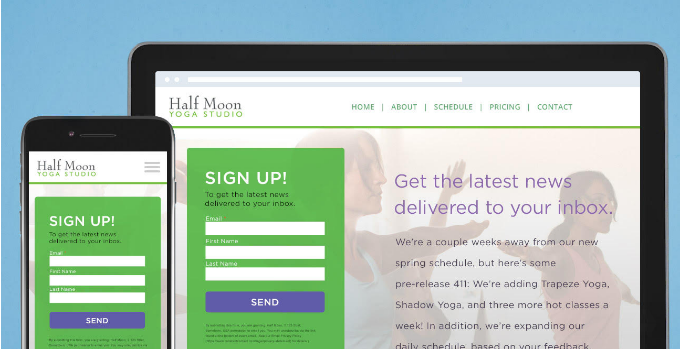
Use these tips to grow your email list!
Whatever you do, don’t be tempted to purchase an email list. Email marketing is all about building and nurturing relationships; connecting with a smaller list of quality contacts will be more impactful than blasting out messages to contacts that don’t even know your business.
3. Add your contacts into your email marketing account
You can start by uploading a contact list from an existing spreadsheet or importing contacts right from a Gmail or Outlook account.
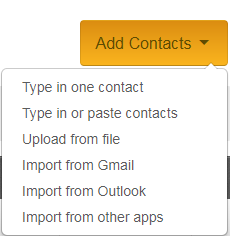
If possible, organize your contacts into separate lists based on what you know about them. For example, if you own a gym, create separate email lists for people who have taken swimming lessons versus those who have attended yoga classes.
That way you can send out a targeted email based on their specific interests.
4. Set up your welcome email
Your welcome email is the first message your new email subscribers receive from you.
Welcome emails are especially important because they serve as your first impression and reach people at a time when they’re highly engaged with your business. You can expect a higher than average open rate for your welcome email, so make sure you’re delivering value right away.
Start with a warm greeting, provide an overview of what they can expect to receive from you in the future, and offer them something useful right away.
5. Create a reusable email template
This is the fun part! Even if you’re not a designer, you can send beautifully-designed professional emails that look good on any device.
Constant Contact has hundreds of email templates for you to choose from — including timely templates to stand out in the inbox.


When choosing a template, look for a layout that is clean, eye-catching, and will get your message across fast. People scroll through the inbox quickly — often while on the go — so choose a mobile-responsive email template that looks good on any device.
Next, customize your template with your brand by putting your business’s logo right at the top of your email and linking the image back to your website’s homepage. Add in your business’s signature colors and create an email footer with your business name, contact information, and links to your active social media channels.
6. Practice writing persuasive messages
This tends to be one of the scariest steps for business owners. I get it — writer’s block happens to the best of us.
What usually snaps me out of it is pretending I’m having a face-to-face conversation with someone and writing down exactly what I’d like to say to them.
It also helps to follow a repeatable process and break your message down into three important sections:
- What are you offering? — Headline
- How will it help the reader? — Message body
- What should they do next? — Call to action

This simple three-step formula helps you stay focused so you can write effective messages fast.
7. Spend time on subject lines
Your email subject line is one of the most important lines of text in your whole email.
Why? Your subscribers see your subject line even before they open your message. Make a good impression and people won’t be able to resist opening. Write something bland and they might skip over your message without a second thought.
Your subject line should be short and snappy — around 40 characters.
You can draw attention by asking a compelling question, including a deadline for urgency, or just teasing your message.
Use these tips to write good subject lines.
8. Preview and test before you send
Especially when you’re first getting started with email marketing, it’s easy to slip up every once in a while.
Maybe you forget to add in an important link or make an embarrassing spelling mistake right in the subject line. Doh! Unfortunately, there’s no Back button with email, so always remember to send yourself or a staff member a Test Email before sending it out to your entire list.
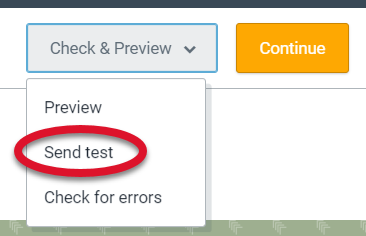
9. Send your email (at the best time)
Every audience is different and the best time to send will differ based on who’s on your email list.
You can also create a consistent sending schedule and stick to it. For example, if you send out a newsletter on the first of every month, your audience will come to expect it in their inboxes.
If you do decide to follow a set schedule, tell people at the point of sign-up by saying something like:
“Would you like to sign up for our Hints & Tips newsletter? We’ll send you a roundup of our top blog posts, upcoming webinars, and best marketing advice on the second and fourth Wednesdays of every month.”
Your subscribers will know when they’ll hear from you next and you can schedule your message to send based on your established schedule.

10. Track your results
Don’t be deceived — email marketing doesn’t end with a send. You will want to track your open rate, click-through rate, unsubscribe rates, etc., and work to improve over time.
Understanding and spending a few minutes in your email reports will tell you valuable information like who opened your email, who clicked on specific links, and what information was the most interesting to your readers.
While it’s important to know how engaging your campaign messages are, make sure you’re tracking actions that happen beyond your emails. How many clicks to your donation page are translating into real donations? What is the total amount of funds raised from a single email?
These are the types of questions that will show you the real impact of your marketing efforts.
for the original article, visit: https://blogs.constantcontact.com/how-to-do-email-marketing-10-things-to-do-first/
If you want to understand "How to build a content marketing strategy" then click on the following link:
https://digitalsnmarketing.blogspot.com/2022/03/step-by-step-guide-on-how-to-build.html

Comments
Post a Comment
If you have any questions regarding the topic, Please do let me know.